
Dichotomies in BJJ
Noodling thoughts

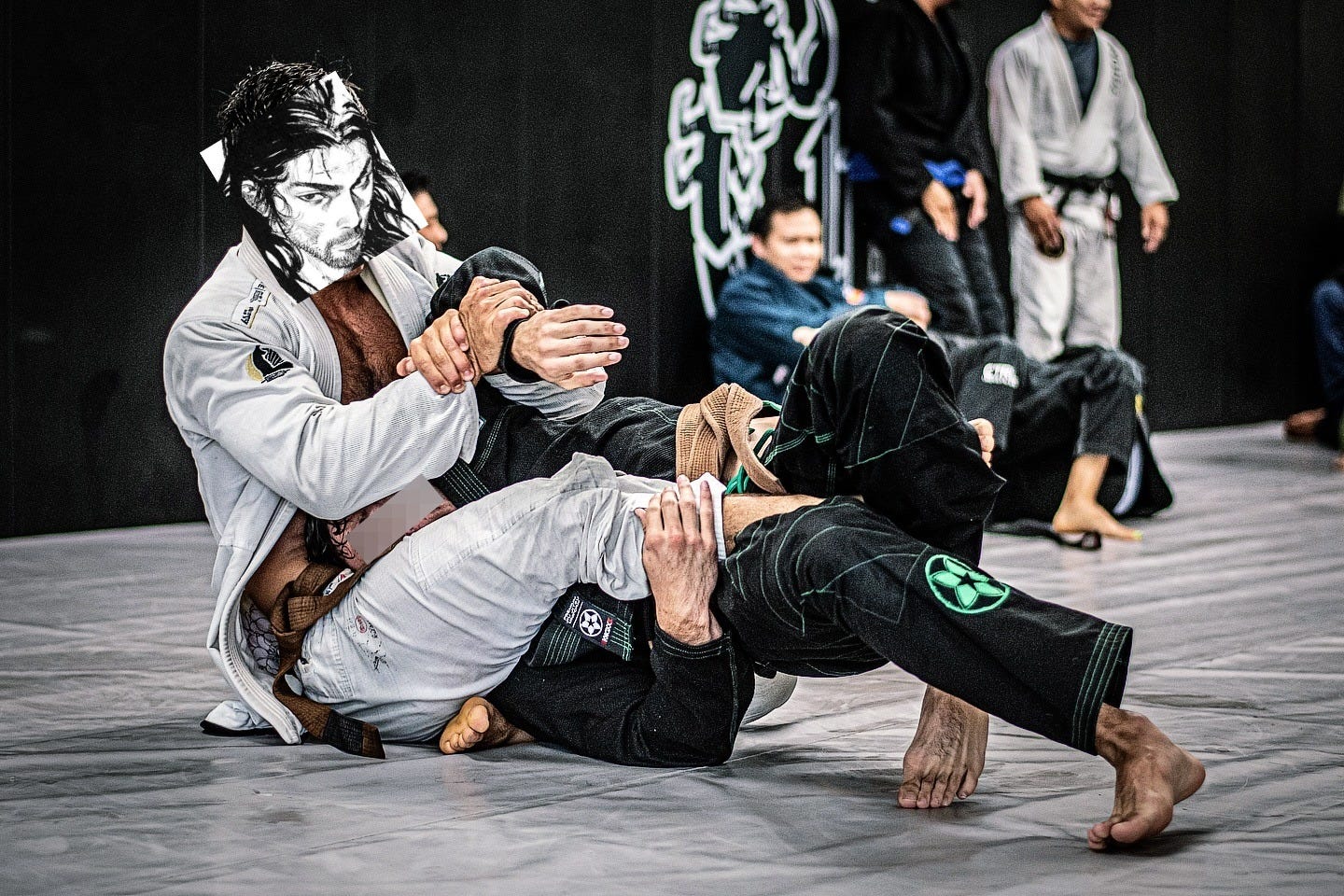
“If you know the way broadly you can see it in all things” - Miyamoto Musashi
Within any sufficiently complex system, there will exist enough dimensions that its meta-concepts will also map onto other complex systems. The threshold is based off of the capability of the human brain rather than any physical law of nature. For example, checkers is not generally used to learn war strategy because it is an easily solved game; anyone that studies it enough can reduce it exactly to a playbook of moves. Chess, on the other hand, is a useful and widely used metaphor for battle throughout history. We know today that AIs have more or less solved the game, but its complexity is still past the threshold required to be a useful map for the brain’s metacognition. “If you know the way broadly you can see it in all things” - in other words, any complex art can serve as a mirror for the brain and the human experience.
Jiu jitsu is a great example: it is (perhaps primarily) a giant salmon ladder of skill development, but it is also a strategy game, a puzzle, and a meditation. It is a scaffolding that so far remains untouched by technology, at least when you’re actually training. At the same time, information that used to be passed down in remote mountain temples and carefully guarded lineages is now being widely disseminated via the internet and an open gym culture. Jiu jitsu today is a curious blend of old spirit and new tech, held together by its epistemic method. This has allowed it to make great leaps forward in development while retaining the human element that makes it such a useful “way.”
Lately I’ve seem jiu jitsu as a combination of axioms and dichotomies. Axioms are direct definitions that we use in the sport. As examples:
To pass guard is to control the inside hip space. This is done by either moving the knees away from the chest or across the centerline.
Guard is having your legs around your opponent or between you and your opponent.
To finish an armbar, you have to pin both ends of the lever arm and apply force to the middle.
Rob Biernacki’s concept of “posture, structure, and base” is also an example of distilling the sport into axioms.
To return to the chess analogy, these axioms are like learning how the pieces on the board move and how the rules of checkmate work. Studying them helps us understand the fundamental nature of Jiu Jitsu.
Dichotomies on the other hand are like learning chess strategies. These are the concepts that apply on a meta level to any sufficiently complex system. One of the most rewarding parts of Jiu Jitsu (or any art) is the ability to graduate from studying axioms to studying strategy & dichotomies. Here are some that I have been thinking about.
Dichotomy: heart vs brain
Or in other words, art vs science. Concepts need to be consciously studied and drilled in the training room, but then integrated into the subconsciousness to be used instinctively during a match. Having only one or the other will create a competitor with a mediocre skillcap.
On the other hand, coordination and execution also has to be developed in the training room, and there are times where during a match you’ll consciously adjust your strategy based on realtime information. It is a yin yang relationship.
Dichotomy: specialization vs generalization
In a game with many potential skillsets and constrained training time, there is a tradeoff of becoming well rounded vs being a glass cannon. Deciding when to double down on a technique or set of techniques (say, becoming a leg lock specialist) vs spending more time on the fundamentals is always a question running through my mind. To an extent, I think personality determines how one approaches this.
Dichotomy: adaptive vs dominant behavior
In a match there is a balance between trying to impose your game on your opponent and taking advantage of whatever opportunities are presented. Focus too much on playing your game, and you become rigid and stuck in a set of moves that might not work. Jiu Jitsu is an interaction between two people, after all. But focus too much on responding and being reactive, and you risk being overwhelmed, or at the least being stuck on the back foot. I’ve seen both behaviors cause people with more technical skill to lose matches.
Dichotomy: ego vs egoless
Jiu Jitsu requires ego, because the desire to win is what drives improvement in the sport. But being unable to lose also severely hinders your ability to grow.
Jiu Jitsu requires you to be selfish, to focus on your own growth and constantly analyze what you have to improve on. But it also requires an investment in teammates and their growth, for the development of your own skill and for the development of the art.
Dichotomy: strategy vs skill
Maybe not a perfect dichotomy, but I think there are always two ways to resolve an issue presented to you: improve your strategy or improve your skill. Everything in Jiu Jitsu can work, but there is a tradeoff of skill for effectiveness. For example, if you are attempting a knee cut on a very flexible opponent but can’t finish, it is possible that you need to spend the next few weeks studying the mechanics of the position to improve your odds of finishing. It is also possible that it would be time better spent to focus on north/south passing, and forego the kneecut when faced with that particular issue. This is a judgement call that you’ll have to constantly make in the training room. “Is this move not working because my mechanics are wrong? Or because I am not setting it up properly? Or are the odds of success just low on an opponent with these specific physical attributes?”
Dichotomy: intimidate vs conceal
There are times when it’s useful to intimidate an opponent in a match, for example by chaining together rapid passing to get them to panic and exert a lot of energy. There are also times when it’s useful to fake tiredness or confusion, to lull an opponent into a sense of security, for example being still for a while in bottom side control before suddenly exploding to escape, or holding single leg X for a while without attacking before quickly catching an achilles straight ankle grip for the footlock. When to do one or the other is a judgement call that requires a sensitivity and understanding of your opponent’s energy state and frame of mind.
The test of a first-rate intelligence is the ability to hold two opposing ideas in mind at the same time and still retain the ability to function.
- F. Scott Fitzgerald
great piece! in fact i’d like to say this is the best piece i’ve read about bjj on here
im a wing chunner & close combat stylist to be clear
so though i dont bjj, chun is stand up grappling where we simultaneously trap & strike
i took a lot from your piece for my own work
and also i celebrate the thoughtful nature and practicality of your piece.
when i open a bjj article on substack it usually is rather valid. an article will praise bjj for “giving us a third space.” when meanwhile all martial arts do that. heck a mcdonals’s does that
to me there’s lots of noise 🧐🧐
your work is frr. you’re an artist 👌👌