
Jiu Jitsu Fast and Slow
A thought on improving faster at BJJ

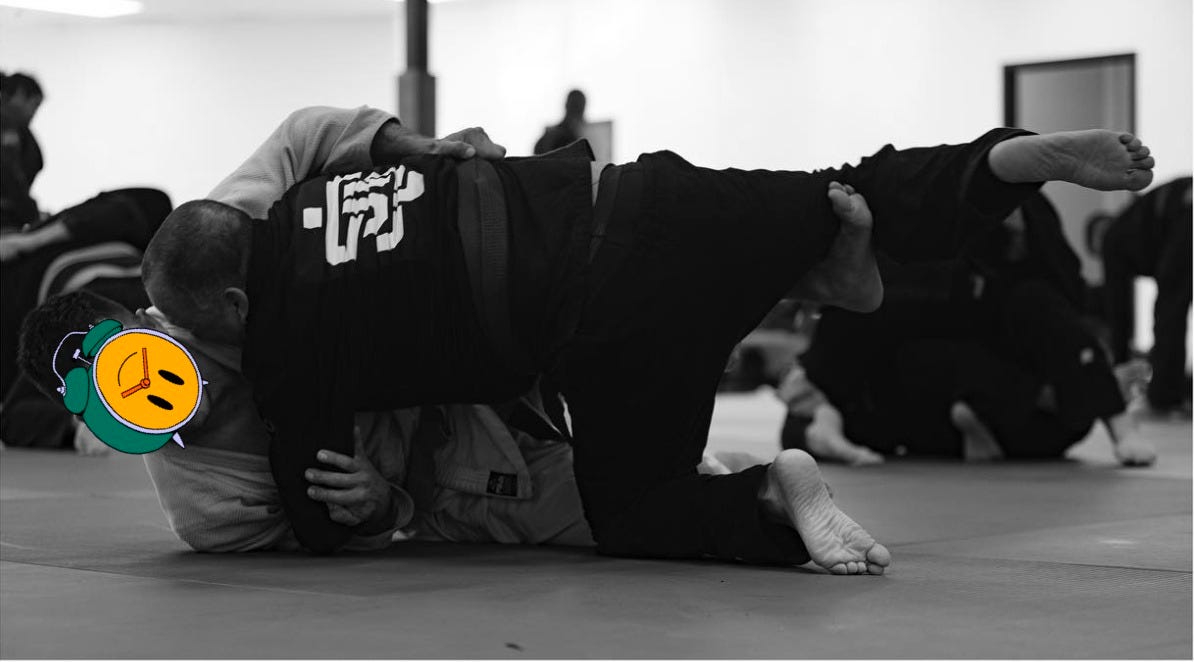
Play the opening like a book, the middle game like a magician, and the endgame like a machine. -Rudolf Spielmann, Austrian chessmaster
I believe it was Ryan Hall that first applied the above quote to jiu jitsu, and I think it’s a great framework for learning how to learn. Amidst the huge number of possibilities available when engaging an opponent from a position with no inertia, choose a few “lines” of engagement and memorize the counters to your opponent’s possible moves (and the counters to their counters). When locked in an unbalanced position, whether on the winning or losing end, understand the mechanics of the position and iterate through a decision making tree to systematically gain complete control (if attacking a submission) or reduce control (if defending a submission). And in the moments of movement and transitions between defined positions, use strategy, trickery, and instincts to gain a decisive advantage.
Keeping this framework in mind has helped me improve faster at jiu jitsu; for example, rather than learning every form of guard and guard pass, I’ve focused on building a system of attacks and counterattacks around a few initial grips I work to obtain while standing or on the ground. And rather than learning one-off submissions from bad positions or trying to spaz out of submission attacks, I’ve focused on systematically addressing aspects of control and working through that decision tree while sparring.
When I brought this idea into the training room I also began to play with another idea on how to structure my training:
The more movement in a technique, the more you should practice against light resistance. The less movement in a technique, the more you should practice against hard resistance.
Simple, right? When the movements you’re working on are complex, your focus has to be internal, developing the smoothness of execution, timing, speed, etc. When the movements are simple, your focus should be external, reacting to your opponents actions correctly more quickly.
Framed another way, the amount of connection you have to your opponent determines how long you have to capitalize on an opponent’s weakness and also how many degrees of freedom they have to respond. So when attempting low-connection moves like shooting a double from a snapdown, hitting a longstep pass, or inverting off a high leg pommel from guard, timing and coordination are key to its effectiveness. For high-connection moves like handfighting in bottom mount, entering deep half guard, pressure passing using over under grips, or hitting Georgian grip sumi-gaeshis, sensitivity to body positioning and your opponent’s direction of force will determine your effectiveness.
Actively identifying the amount of movement in a new skill and adjusting the amount of resistance it is practiced with can accelerate the absorption of that skill, for example choosing to drill reps on a compliant partner for a low-connection guard pass and then working on a positional spar at 50% intensity with constrained win/loss conditions for maintaining side control after the pass.
This sounds intuitive, but it took me several years to learn to approach training sessions this way. Often I would actually do the opposite and drill low-movement moves like triangle adjustments or standup handfighting against low resistance, only to follow that up with wild sparring and go 100% for outside double legs, longsteps, and rolling backtakes against equally motivated opponents. This looked like a lot of scrambling and not a lot of learning, not to mention higher risk for finger sprains, scratches, or other more severe injuries. Walk into your average BJJ gym and I think this would not be an unfamiliar pattern.
This is not to say that doing a bunch of scrambling around on the mats for a few years will not make you improve; mat time still counts. But I think in this case, it is better to train smarter AND harder.
This simple paradigm of high/low movement moves and their respective training methodologies can also help us understand why different martial arts have different training styles. In general, Jiu Jitsu emphasizes live sparring because as a ground art we engage in lots of positions with high shared surface area and locked loops around our opponent. We are weaker at takedowns because this training methodology works less well; the standup techniques we are the best at generally involve loops of some sort like armdrags, front headlocks, and Russian ties. Judo and wrestling are largely standup arts, and so center their trainings more heavily around low-connection principles: drilling techniques into instinct and developing athleticism. Imagine doing uchikomi for a darce! At the far extreme, an art like boxing involves almost no loops or surface area and so focuses the majority of its training time on low-resistance drills (hitting pads and heavybags) and athleticism (roadwork, jumprope, etc).
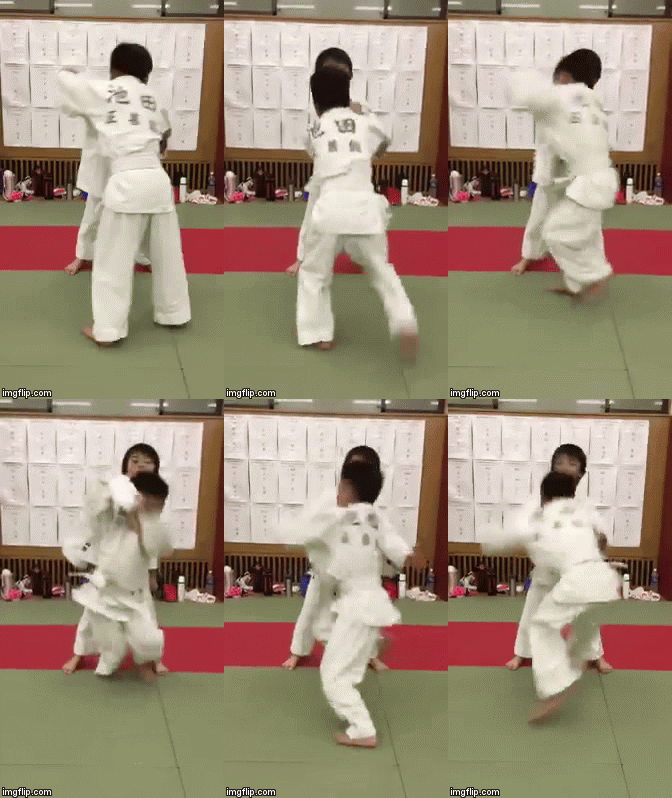
So keep this simple concept in mind when looking at your next cycle of skill development in a grappling art and see if it helps!