
Top Down & Bottom Up Learning
A Skill Development Framework

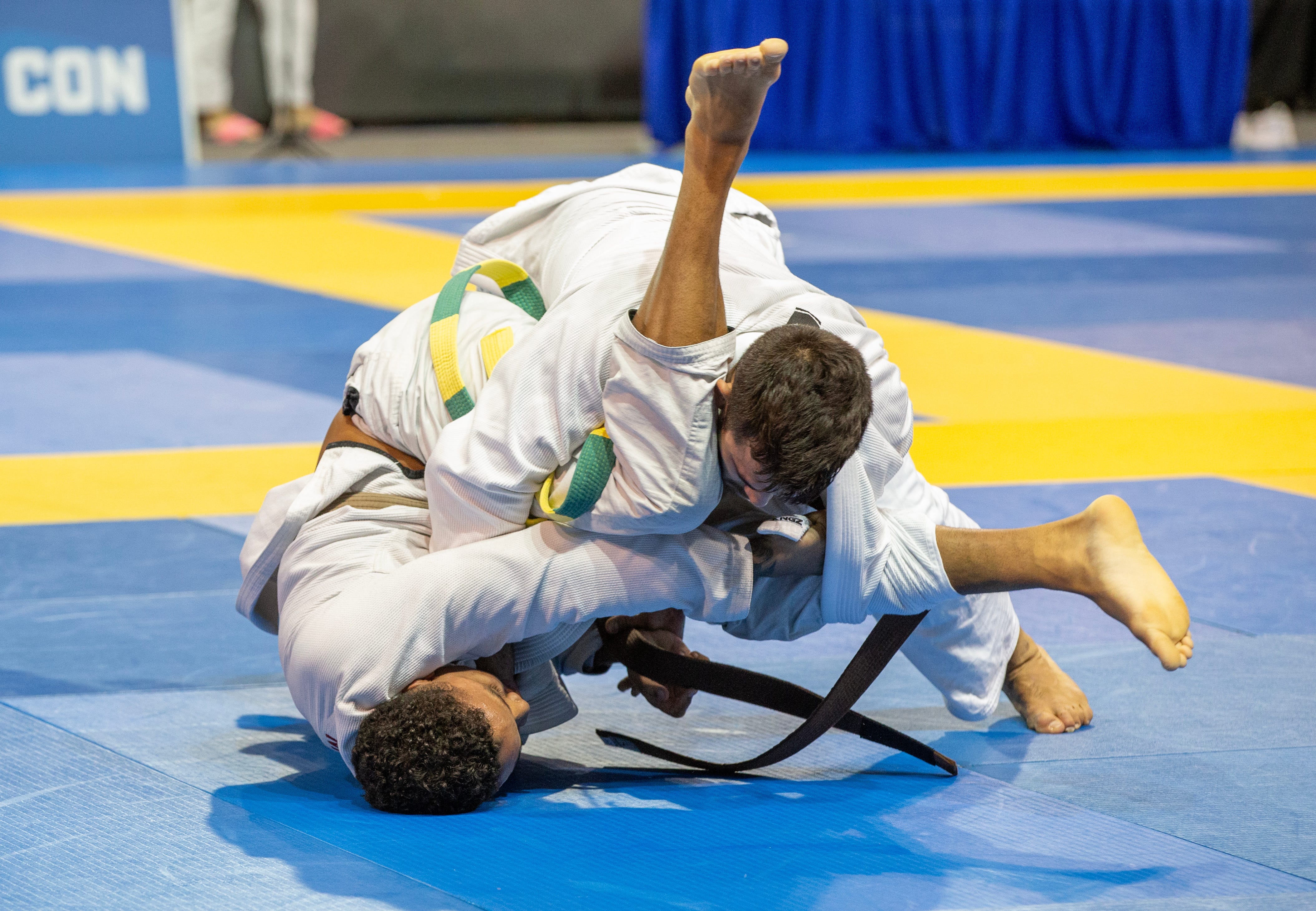
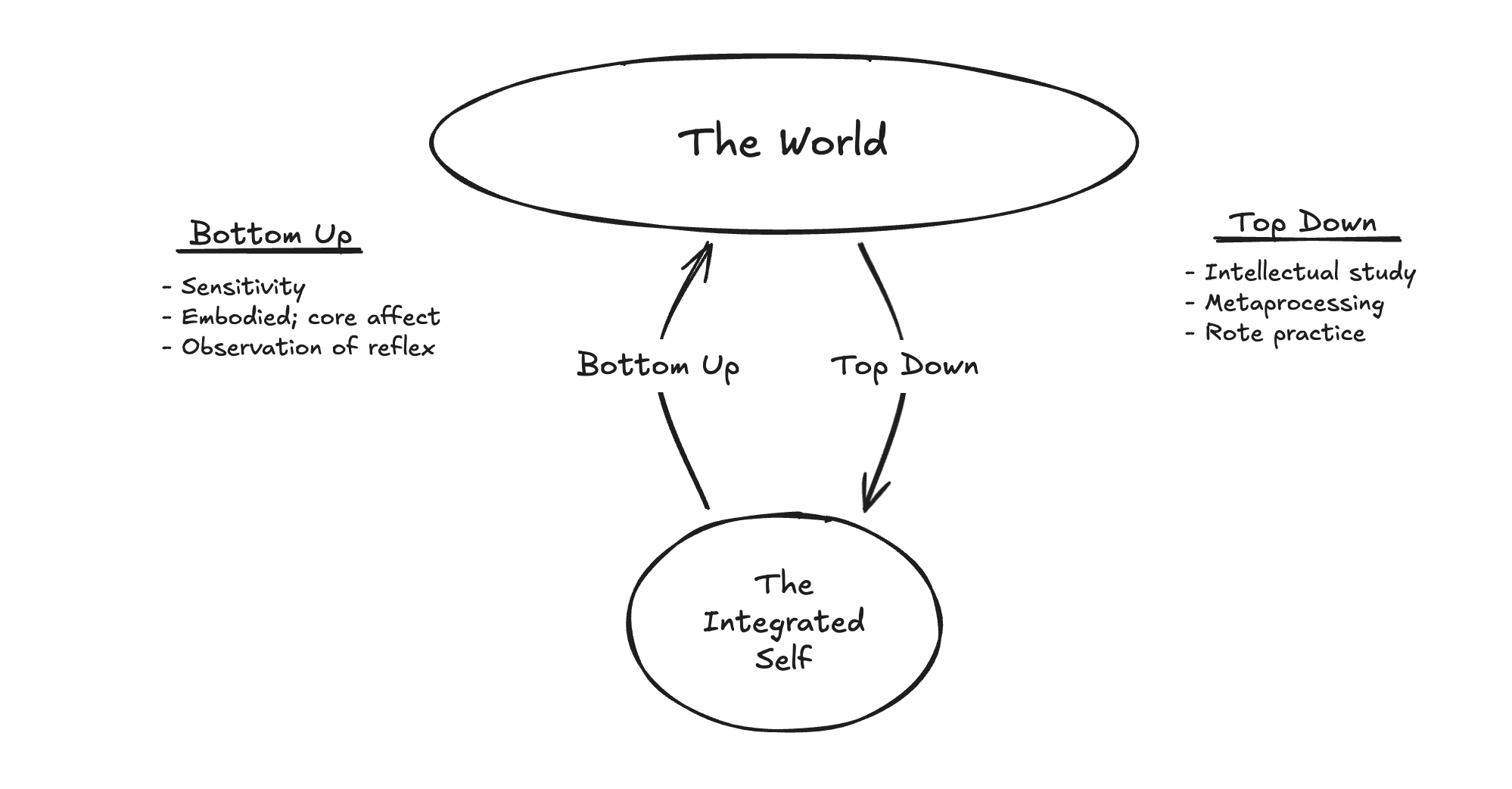
One evening after two days of very little sleep I was sitting at our dinner table pondering how to improve faster at Jiu Jitsu. I ended up deep in a conversation with my new roommate who is training to become a therapist, and by the end of it we had realized that the way we thought about practice and growth were surprisingly similar. By the end of the night we had sketched out this broadly applicable framework for skill development:
When learning a skill the goal is to build Integration
New skills, patterns, and behavior can be built with Top Up and Bottom Down approaches
Top Up and Bottom Down approaches are defined in turn by cultivating sensitivity, and intentional implementation
In a way this is extremely intuitive. To rephrase the above, skill is basically a set of actions that combine knowledge and execution; to develop it you have to work on both knowledge and execution. It’s also an extension of the heart vs brain dichotomy I touched on in my last post about Jiu Jitsu. Like a lot of pedagogy, it’s not that complicated when you get down to it. The trick is to recognize when and where it applies in life, and actually follow through with applying it.
Integration
The first step to doing something is identifying what you’re actually trying to do. When training, the goal on the mats is not to just “win” or “execute better.” Ideas like “have fun” or “get 1% better everyday” while motivational don’t provide directional guidance on how to actually improve. The goalpost is integration.
An integrated self is one that contains external knowledge and skill, while also having that knowledge fully absorbed in the subconscious and reflexive behaviors. This means the self is able to contextualize that knowledge with respect to both the external environment (instructionals in the case of jiu jitsu, scientific papers in the case of therapy, peers, etc) and the internal environment (the preferences of one’s unique body and personality, and the strengths and weaknesses therein).
In Jiu Jitsu, integration might look like having a “game” of a set of dilemmas from the standing under hook position, with knowledge of their names, history, and how they chain into each other. At the same time, it would be having an intuitive understanding of each position, a reflexive, no-thinking-required response to opponent reactions, and the ability to flexibly adapt to how their physical attributes pair up with yours (say, changing stance if they are quite tall, or heavy & slower with their positioning).
In therapy, integration might look like having the sensitivity to recognize the hidden emotion and trauma in a story from a patient, and then being able to seamlessly map it to best practice procedures based on clinical research. And vice versa, it could mean sensing when typical schemas don’t apply and charting new territory to accommodate non-standard situations.
To quote Mina’s writeup:
Tai and I concluded that mastery and healing are governed by the same architecture. In learning, the synthesis of top-down study and bottom-up embodiment gives rise to mastery. In therapy, the synthesis of bottom-up emotional processing and top-down integration gives rise to healing. And in both, the destination is the same: integration.
The mark of a true master is not the acquisition of knowledge and skill, but their integration and internalization such that they can seamlessly present themselves as instinct.
Top Down Bottom Up
To improve our skill we can take two approaches. We can take external knowledge and try to integrate it into ourselves via studying and drilling, or we can practice our skills intuitively and then try to observe and extract learnings from it. On a micro level, this type of implementation + feedback + adjustment is something I think we’re all familiar with. You like to play basketball, and you see a new type of hook shot highlighted on YouTube. You go down to the court and try it twenty times to get a feel for the movement pattern. This is Top Down. In the next pickup game you keep shooting short, you recognize this and put a bit more strength into your wrist at the end of the shot. This is Bottom Up.
Where this framework gets interesting (to me) is when it is applied on the timescale of weeks and months as a way to structure a training plan. For example, I try to spend one to two months at a time alternating between top down and bottom up training.
Let’s start with a bottom up period. The goal here is to observe the current state of the skill. This might come from an analytical place: it could look watching match film or soliciting feedback from training partners. It could come more directly: I’ll spend time trying to go deep into the mind body connection and stretching the limits of sensitivity, awareness, and flow. It can also come from visiting high level gyms to get challenging rolls that highlight weaknessses. After a month or two of this, I’ll generally feel like I’ve become a better athlete, that my flow has improved and that I’m “sharp” so to speak. I’ll also have a laundry list of things to improve.
Next comes the top down period. After consolidating the list of shortcomings into a main ideas, the goal now is to bring down new information and integrate it into the self. This can be pulling from external sources (ie match study, instructionals) or self-directed analysis and discussion. In all cases, the knowledge is entering the body top down - from the brain. After a short period of drilling, the goal over the next month or two is to slowly build these new ideas into reflexes. There is none of the flow & sensitivity & rhythm from the bottom up training period - this is all about mechanical execution, observation, and repeated study. Once these ideas start to feel reflexive, I will transition back to a bottom up period, and the cycle continues.
In therapy, there is a concept of “core affect,” or a truth of what is happening internally in a patient’s body. Developing a sensitivity to the core affect is a bottom up skill. The metaprocessing of these feelings, categorizing, analyzing is a top down skill.
Broadly, top down is feedback, conversation, studying, drilling. Bottom up is sensitivity attunement, honing reflexes, stretching the limits of perception. This can be applied to nearly every skill in life, from sport to sex to writing to conversation to scientific research.
Sensitivity and Praxis
Both halves of top down / bottom up have a method of practice: one is sensitivity & adjustment, one is analysis & application. Both are skills that can be developed, on the praxis side by building a more quantitative, analytical mind that cuts away excess thought and defines cause and effect, and on the sensitivity side by embracing and stretching the limits of sensation and awareness, by observing the self without interrupting its flow.
If you are only top down you can overly intellectualize - your knowledge is calcified into general principles and not adaptive to specific environments. It is unable to be implemented in real life when immediate response and reflexive intuition is required.
If you are only bottom up you can become self-referential, stuck in limited patterns, out of date with the world, unable to teach, and in general slower to develop since you aren’t receiving new patterns and ideas from the broader human machine.
Critically, one also has to be able to exit the realm of study and enter the realm of execution. The whole primary value of a skill, after all, is to use it. In these cases neither top down nor bottom up methodologies are valuable - all mental and physical energy should be attuned to the external, and action and behavior should be fully trusted to the integrated self. Sometimes, videos and observation from coaches or other knowledgeable parties can loop performance back into the cycle of learning, but in the moment it’s just about sinking into the pool of your expertise. When the typical aspects of the human experience have been ingrained into the subconscious, there’s room in the brain for higher order thought and experience. This is the beauty of the flow state.
My housemate Mina wrote her thoughts on the topic as well! In beautiful prose I might add. See: